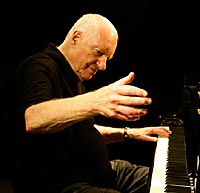




Mike Westbrook 1936 -2026
More Tributes
More Tributes
Duncan Heining wrote the following obituary for UK Jazz News
Mike Westbrook was as English a composer as Ralph Vaughan Williams or Michael Garrick and as European a composer as Benjamin Britten or Barry Guy. Largely self-taught, with each new work, he would set himself a new set of compositional challenges – perhaps an unusual combination of instruments, a different approach to framing his wife Kate’s texts or self-imposed harmonic limitations that might open wholly new possibilities for his work.
We spoke days before his ninetieth birthday. Westy proposed to celebrate with a rehearsal for a new composition that involved finding a way of celebrating and sounding some ancient church bells that local bassist and sculptor Marcus Vergette was seeking to preserve. He was excited to find out what the music would sound like and discover whether he had realised his idea for the composition. The rehearsal was to be followed with afternoon tea with the musicians and maybe one or two other friends.
The regret that Mike Westbrook’s career was not more fêted in his home country says many things. It speaks of a mean-spirited, small-minded and, no contradiction here, class-ridden national culture. Cook and Morton’s point is well-made and needs repeating but it is far more important here to celebrate the riches of Westy’s career.
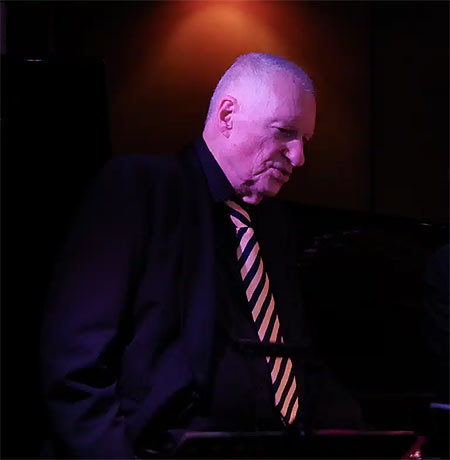
Mike Westbrook at Ronnie Scotts
photo: Robert Crowley
photo: Robert Crowley
Though born in High Wycombe, Mike grew up in Torquay, forging a love for the Devon countryside and landscape, not least its moors. National Service took him to Germany, its war-scarred cities leaving a lasting impression that would provide inspiration for Marching Song (Deram 1970),one of his greatest achievements. After discharge, he studied art in Plymouth, where he first formed a jazz group, which would include AMM guitarist Keith Rowe and saxophonist John Surman.
Moving to London in 1962, he taught art at West Drayton Grammar School, where one of his pupils was saxophonist Alan Wakeman, who would later become a Westbrook alumnus. By the mid-sixties, Westbrook was running a sextet featuring Surman, saxophonist Mike Osborne, trombonist Malcolm Griffiths, South African bassist Harry Miller and drummer Alan Jackson. These musicians would form the nucleus of the Concert Band and, from 1965-67, both the sextet and Concert Band were regulars at Ronnie Scott’s Old Place in Gerrard Street, a fact celebrated by the release in 2018 The Last Night At The Old Place (Cadillac) featuring the Concert Band.
All this is the necessary stuff of biography but a list of dates or recordings barely touches the real story, which is formed by the warp and weft of a life of music-making. The four Deram LPs – Celebration (1967), Release (1969), Marching Song (1969) and Love Songs (1970) – were jazz classics that heralded a freer, more dramatic approach to the jazz big band but they, and the Westbrook Orchestra album Metropolis (RCA 1971), rather cemented the impression on the jazz scene of Westbrook as a composer of grand scale works. Rather, as he was keen to point out, his career and music have been characterised by many perfectly crafted small group works, many of which drew upon the other arts for inspiration. His marriage to artist and later musician Kate Barnard in the mid-seventies, enriched this aspect of his work still further.
Westy’s inspirations were manifold. From jazz, Ellington towered above all others and his tribute to the great man, On Duke’s Birthday (Hat Art 1985) perhaps meant more to him than any of his other albums. But there was Mingus in his music as well and, indeed, Westbrook’s music was in some senses both a celebration of and a discourse with the jazz tradition. From the dramatic arts, inspiration came from Bertolt Brecht and from literature William Blake. Blake was central to Westbrook’s art, not just as an artist but also as a kind of moral compass.
In the early seventies, Mike worked extensively with John and Sue Fox of the Welfare State International theatre company, not least on the extravaganza Earthrise performed at the Mermaid Theatre in November 1969. Poet Adrian Mitchell was another like soul and they collaborated on Tyger, a musical based on Blake’s life and also on White Suit Blues, another musical this time based on the life of Mark Twain.
There were other theatre-based projects, as well. Mama Chicago, described as a jazz cabaret, was first performed in London in 1978 with a recording released by RCA the following year but the smaller scale The Ass, inspired by D.H. Lawrence’s life and the poem of that name, and Paintbox Jane, inspired by the paintings of Raoul Dufy, meant just as much to Westbrook. Perhaps one of his biggest regrets was that his opera, Coming Through Slaughter, based on Michael Ondaatje’s novel about cornetist and jazz pioneer Buddy Bolden, received just two performances and still awaits a revival. It is a remarkable work that surely deserves performance and recording. Sadly, there are too many ‘to be continued’ threads like this the tapestry of his musical life.
Like many British jazz musicians, the Westbrooks found a more receptive audience for their ideas and talents in mainland Europe. For years, the Westbrook Brass Band criss-crossed the continent, both east and west, performing everywhere from shopping malls, factories and street corners to concert venues. The band’s recording The Paris Album (Polydor 1981) demands reissue. Equally shamefully, the epic albums The Cortège (Original 1982) and London Bridge Is Broken Down (Virgin Venture 1988) are missing in action, though their absence is compensated for by the recent releases of London Bridge: Live In Zurich 1990 (Westbrook 2022) and The Cortège: Live At The BBC 1980 (Cadillac 2025).
Mike was a serious-minded, reflective and intensely private person. He was also generous, warm and kind and he laughed easily. Perhaps more than any musician I have ever known, Mike Westbrook believed in the transformative power of jazz and of the arts more broadly. It was a passion shared by his partner and collaborator, Kate. At the same time, that potential had to be worked at if it were to be realised and both set themselves the highest artistic standards.
Of the smaller scale works Art Wolf (Altrisuoni 2005), inspired by Swiss painter Caspar Wolf, The Serpent Hit (Westbrook 2013) and Kate Westbrook and the Granite Band’s Earth Felt The Wound (Westbrook 2022) stand tall. Their trio with saxophonist Chris Biscoe was both one of their most accessible incarnations and artistically both effective and affecting. Moreover, even in his last years, there was no slackening. The Devon-based Uncommon Orchestra’s A Bigger Show (ASC 2016) and Band Of Bands (Westbrook 2024) were as joyous as they were significant musical works, while a series of solo piano recordings, most notably Starcross Bridge (hatOLOGY 2018), offered a different set of glimpses into Westy’s musical mind.
Mike Westbrook shaped our musical culture for more than sixty years. The loss seems very great but how much more so for Kate, who has lost a life and artistic partner? Our thoughts are with her. The heavenly choir just acquired a new and unique MD. Rehearsals are likely to be exacting with last minute rewrites inevitable.
MIKE WESTBROOK, A REMEMBRANCE
Enzo Capua (Musica Jazz, May 2026)
Enzo Capua (Musica Jazz, May 2026)
The year was 1973, London. When ‘London’ meant the world for us locals living in the provinces of Italy. Then no longer the Swinging City of the Sixties, maybe - but for us its streets were still smelling of the intense scent of exotic spices that had nurtured our adolescent years. Having just come of age, we now eagerly ran to find Abbey Road in hope to be walking on that pedestrian crossing we’d so often dreamed of in our bedrooms before and after (sometimes even during) our school homework. London, for the curious and music-hungry people that we were, wasn't just the Marquee Club or the wind of rock music that had furiously swept away our domestic Sanremo Festival nonsense: it was also the source of the new British jazz, blowing strong and vigorous, permeated by rhythmic thunders that emanated from the music of our time - Rock - and reshaped a sound fresh and original like no other. Miles Davis, who had rightly wanted Holland and McLaughlin by his side, understood this before anyone else. We lads from the Italian provinces knew nothing of it yet, or were only just beginning to catch a glimpse of it.
In 1971, in that late winter, someone came back from there bringing an album whose cover alone hinted at thrills and mystery, those bare streets dimly lit by streetlamps that hardly pierced the thick British fog. It was ‘Metropolis’, a wonderful album, which we endured listening to secretly, like some Carbonari, after parties with girls who obviously wanted the Beatles, dreamed perhaps of the Doors, certainly loved the Rolling Stones, and got excited for Led Zeppelin, but not more than just that. Author, inventor and conductor of that ‘Metropolis’ was actually a young British gentleman named Mike Westbrook, still in his mid-thirties at the time; we teenagers would follow him forever since then all through his brilliant career, and never ever forgetting about him. This we’ll keep on doing even more so from today, April 11th, day when he left us soon after turning ninety.
Back to that London 1973: avid readers of that musical bible Melody Maker that we were, we’d just read between the lines of an upcoming concert in a small theater, not even in central London, with Westbrook and his new band, Solid Gold Cadillac. Not the big orchestra that we'd hoped for, but there he was for real - conducting and playing electric piano, along with two guitarists fabulous in their prime and now legendary, Chris Spedding and Brian Godding. A crazy, adorable saxophonist was there too, with his unpredictable interventions turning the tables on Westbrook himself, caught looking slyly at George Khan - yes, him! – while performing with his back to the audience: we had already taken note of him in ‘Metropolis’ and we would soon admire him again a few days later in an astonishing performance at the 100 Club.
That concert of Solid Gold Cadillac was highly impressive, at times too loud due to a poorly managed sound system, but that music touched our hearts deeply. It was a mix of languages, from avant-garde jazz to rock to soul, blended - or rather, shaken as in cocktails - in an original way by that wizard at the keyboards, a conjurer who would prize us with innumerable beauties in subsequent years. We felt privileged - and that’s what we were, really - so much so that we tried to meet him at the end, but didn’t succeed for the simple fact - it may seem ridiculous today, not so for penniless kids back then who had come to London to learn English - that we were almost late for our last train. Traveling by taxi was unthinkable: way too expensive.
In any case, time, passion and determination made it possible - at least for me - to meet Mike Westbrook in person, years later. A true gentleman, a distinguished man, a master of highly original musical arrangements. A friendly person who immediately put you at ease. Had he so wanted, his name would likely be much more widely known today, far beyond the borders of Britain and Europe. In my personal opinion - but one that I know is shared by many - Mike Westbrook is the most important composer and arranger that English jazz has ever had. Despite all the inevitable ups and downs, he has always pursued with sincere passion the search for refined, never obvious solutions, bringing together different languages and styles under a single vessel: his own.
This here is not the place to recount in much detail a long and outstanding career, one need only think of his ‘Off Abbey Road’ and ‘Westbrook Rossini’ albums, the beloved Duke Ellington - whom he revisited on numerous occasions - William Blake, the sublime ‘Metropolis’ and ‘Citadel/Room 315’, and the numerous other visionary projects, reinterpretations and displays of personal unconventionality that have permeated his entire output. Furthermore, every single musician in the league of British jazz that emerged in the late 1960s owes him at the very least a debt of infinite gratitude.
Our friends in Catania also owe him a debt of gratitude: in July 1992 a three-day festival was held in his name there, leading to the release of the very fine double album ‘Catania’, recorded with his Orchestra, which remains one of the most captivating works in Westbrook’s catalogue, even more than thirty years after the event. At this very moment, I am listening again with devotion to his latest solo piano albums: collections of dozens of rare gems suffused with a gentle melancholy, which I highly recommend listening to carefully, with the right frame of mind. There is no trace of the original, irreverent and multi-dimensional bandleader: here instead is the pianist, the mature and wise musician absorbed in his instrument, tracking who-knows-what distant memories, what familiar or unknown melodies, what musical loves still belonging to him after a whole life spent chasing them. A life told through notes, chords and sounds gathered along the path of an admirable journey, one that remains unique in its sincerity and honesty. Truly admirable qualities in a true Artist who never stooped to commercial trivialities and who always followed a sole guiding principle: himself.
With thanks to Sergio Amadori for the translation
- Home (Main Page)
-
Mike Westbrook Pages
- Mike Westbrook Tribute
- Latest Recordings
- Selected Compositions and Recordings
- Diary
- Biography
- Recordings
- Complete Works Page 1
- CompleteWorks Page 2
- Sound Samples
- Mike's 85th Birthday
- Mike's Selected Films
- Westbrook Newsletter (SAI) Archive
- Photo Album
- Links
- Contacts
- Lou Gare Tribute
- WestbrookBand Alumni - Featured Albums
- Shop
- News
- Notice Board
- Films

Mike Westbrook